Short answer
Laghman is a Uyghur and Central Asian dish of hand-pulled wheat noodles served under a stir-fry of meat and vegetables. The name is spelled many ways, and the noodles are pulled by hand rather than cut or extruded.
Laghman is a Uyghur and Central Asian dish of hand-pulled wheat noodles served under a stir-fry of meat and vegetables, and it is often described as the everyday noodle dish of the region. The dough is made from flour, water and salt, rested, oiled and stretched into long strands. This guide explains how the noodles are made, how the topping works, the soupy and fried styles, the many spellings, and what the Bostan Uyghur Cuisine menu lists as of November 2026.
What is laghman?
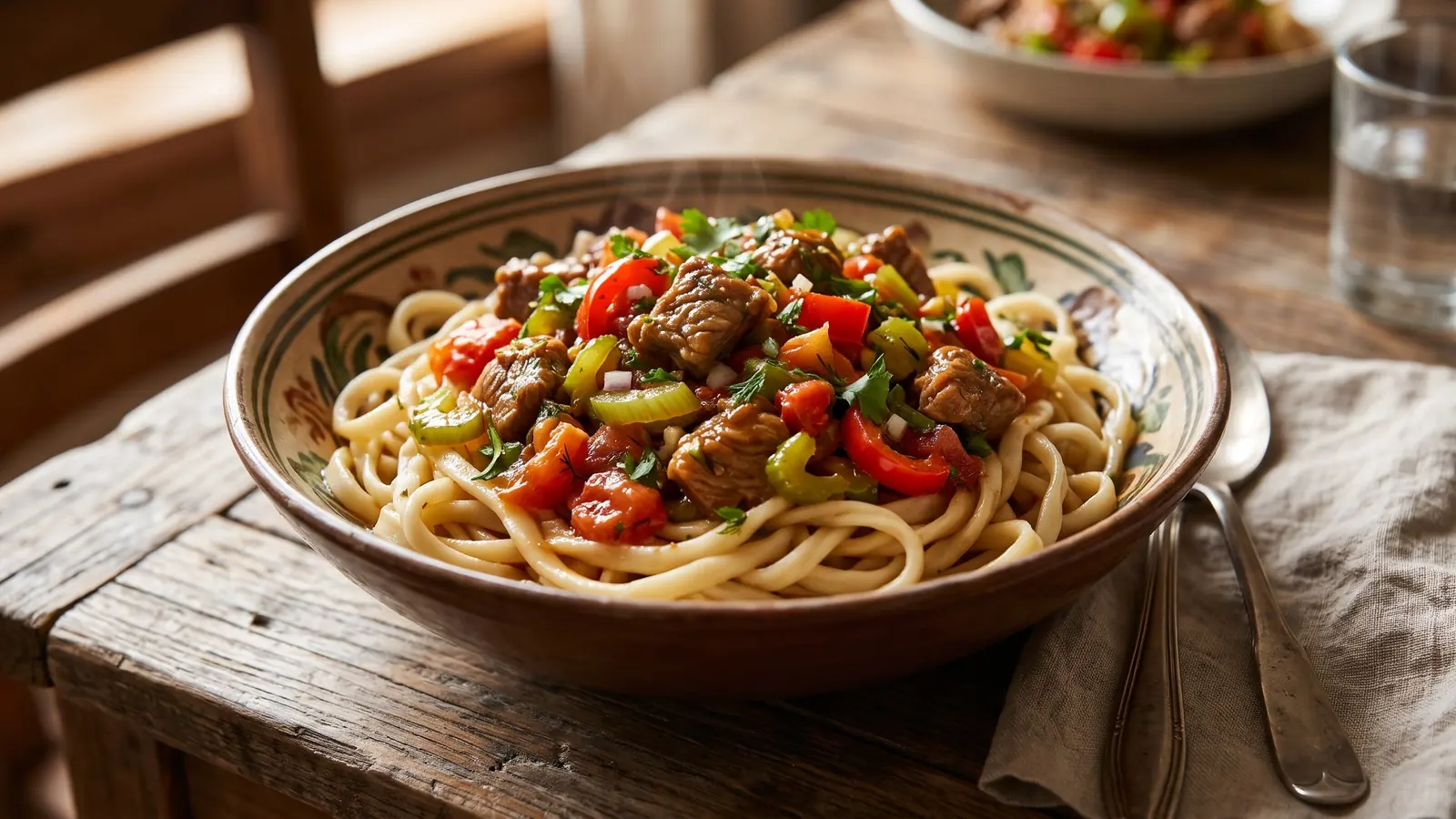
Laghman is a bowl or plate of stretched noodles with a topping cooked separately. The noodles are boiled and placed in a dish, and a stir-fry of meat, onion, peppers and other vegetables goes over the top.
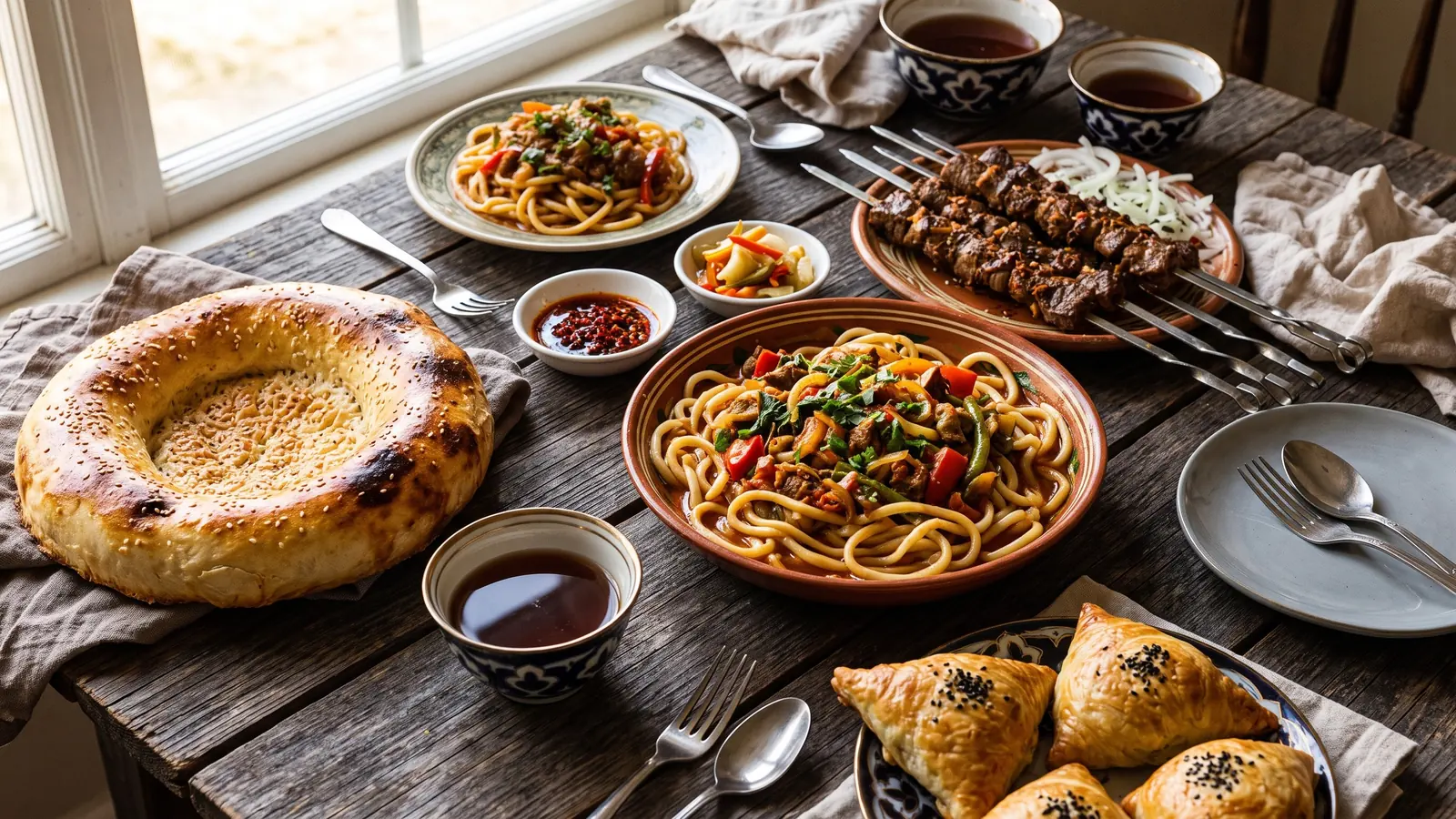
The name is shared across the Uyghur, Uzbek, Kazakh and Kyrgyz kitchens, and the dish exists in several local versions. In the Uyghur version the sauce is thick and clings to the noodles. In some other versions the dish is served closer to a soup, with more liquid.
The word itself is generally traced to the Chinese term for pulled noodles, la mian. This is the usual explanation, though language histories like this are rarely settled with certainty.
How are laghman noodles made by hand?
Laghman noodles are made by resting a simple wheat dough and then stretching it into long strands by hand. There is no machine and no cutting, which gives the noodles an uneven, chewy texture.
The usual steps look like this:
- Mix the dough. Flour, water and salt are kneaded into a firm dough. A little extra water makes the dough easier to stretch.
- Rest it. The dough sits, covered, so the gluten relaxes. This step matters more than most cooks expect.
- Roll and oil. The dough is rolled into thick ropes or coils and coated with oil so it will not stick or dry out.
- Stretch. Each rope is pulled out and folded back, over and over, until it becomes a long noodle. The cook often slaps it on the counter or swings it to help.
- Boil. The strands go into rapidly boiling water for a short time and are lifted out as soon as they are cooked through.
The exact methods differ between cooks. Some pull the dough free in the air, some coil it first, and some roll it flat and stretch it from there. What stays the same is that the noodle is a single long piece, not a cut shape.
What goes on top of laghman?
The topping, often called sai in Uyghur cooking, is a stir-fry of meat and vegetables cooked in a wok over high heat. It is the flavor of the dish, and the noodles are the base.
Typical ingredients are lamb or beef, onion, tomato or pepper, garlic and a few vegetables. Seasoning is usually cumin, black pepper and a small amount of chili, with vinegar or soy sauce in some versions. The topping is cooked fast, so the vegetables keep some crunch.
The Bostan special Lagmen on the online ordering page is stir-fried beef (beef only) with cabbage, red and green pepper, chive flowers and black mushrooms, served over house-made wheat noodles. It is listed at $17.99 on its online ordering page as of November 2026. The same page lists a Hand made noodle for Lagmen at $5.99 for extra noodles.
What is the difference between soupy and fried laghman?
Soupy laghman has the stir-fry in a broth or loose sauce, and fried laghman, sometimes written as suoman or somen, has the noodles tossed in the wok with the meat and vegetables. The two are related, but they eat very differently.
| Style | How it is served | Texture | Common names |
|---|---|---|---|
| Sauced laghman | Boiled noodles with a thick stir-fry on top | Chewy noodles, saucy topping | Laghman, lagman, lagmen |
| Soupy laghman | Noodles in broth with meat and vegetables | Soft, liquid | Lagman soup, in some Central Asian kitchens |
| Fried noodles | Noodles stir-fried together with the topping | Slightly crisp edges, drier | Suoman, somen, suomian, chao mian |
On the Bostan menu, the chewy sauced style is the Bostan special Lagmen. The fried style appears as dry fried somen with housemade noodles, a wok-fried dish of wheat noodles with beef and vegetables at $17.99, and as chop fried somen, finely cut wheat noodles stir-fried with chopped meat, tomato, cabbage, red and green pepper, sweet onion and celery, at $18.99, both as of November 2026.
Note that the menu spells it somen. Elsewhere you may see suoman or suomian. There is no single standard romanization, so go by the description rather than the spelling.
What are the other spellings and names for laghman?
Laghman is spelled laghman, lagman, lag’mon, lagmen and la mian, among others, because the word is written in several alphabets and transliterated differently. They all point to the same family of pulled-noodle dishes.
| Spelling | Where you see it |
|---|---|
| Laghman | Common English spelling for the Uyghur dish |
| Lagman | Russian-influenced and Uzbek spellings |
| Lagmen | Used on the Bostan menu |
| Lag’mon | Uzbek spelling |
| La mian | Chinese for pulled noodles, the family the dish belongs to |
If you search for the dish online, try more than one spelling. A recipe under lagman may give a different result from one under laghman, though the two often describe the same dish.
Laghman vs lo mein vs lamian: what is the difference?
Laghman and lamian are both hand-pulled noodles, while lo mein is a different dish of cut or extruded noodles tossed in sauce. The names look alike, but lo mein is a Cantonese-style stir-fried noodle and is not pulled.
| Dish | How the noodle is made | Cooking style | Usual flavors |
|---|---|---|---|
| Laghman | Hand-stretched wheat dough | Boiled, topped with a stir-fry | Cumin, pepper, onion, vinegar |
| Lamian | Hand-pulled wheat dough | Often in soup, or stir-fried | Varies by region of China |
| Lo mein | Cut or extruded egg or wheat noodles | Boiled, tossed in sauce | Soy sauce, sesame oil |
| Chow mein | Cut or extruded noodles | Stir-fried until partly crisp | Soy sauce, vegetables |
Laghman is closer to lamian than to lo mein, and the two share an origin in northern Chinese noodle making. The difference is mostly the topping and seasoning: cumin and lamb in Uyghur cooking, and soup broths and beef in many Chinese versions.
What are ding ding noodles?
Ding ding noodles is a name used on some menus for short, small pieces of noodle dough cooked in a stir-fry or a sauce. They are related to laghman in using the same kind of wheat dough, but the shape is different.
This is a name that is not standardized, and different restaurants use it for different shapes. Because of that, it is more reliable to read the menu description than to rely on the name. The Bostan menu does not list a dish under that name, so this guide does not describe a specific one.
How do you eat laghman?
Laghman is eaten by mixing the topping into the noodles before the first bite. The sauce needs to coat the strands, and a plate that stays layered will taste unevenly seasoned.
Use chopsticks or a fork, whichever is available. Lift the noodles from the bottom and fold them through the topping a few times. Chili oil or vinegar, if offered, goes on after mixing so you can judge the heat.
Fried noodle dishes like somen are best eaten while hot, since the noodles stiffen as they cool. For a sauced plate there is more room, but the noodles still soften as they sit in the sauce.
What can you substitute for hand-pulled laghman noodles?
The best substitute is fresh wheat noodles with some chew, such as fresh udon or thick fresh Chinese wheat noodles. Dried spaghetti works in a pinch, though it lacks the uneven, springy texture.
A few points help the result:
- Choose thicker noodles for sauced laghman. Thin noodles go soft under a heavy topping.
- Cook the noodles separately and drain them well, so the sauce stays thick.
- Cook the topping fast over high heat, as the original does.
- Skip long storage. Cooked noodles stick together; toss them in a little oil if they must wait.
Making the dough yourself takes practice, and a first attempt may produce uneven strands. That is normal, and the result still tastes right.
What mistakes spoil laghman at home?
The most common mistakes are skipping the rest, overcooking the noodles and making the topping too wet. Each one has a simple fix.
- A dough that was not rested springs back when pulled and tears. Give it time covered, and rest it again if it fights you.
- Overboiled noodles turn soft and lose the chew that defines the dish. Taste a strand early and drain as soon as it is cooked through.
- A watery topping slides off the noodles. Cook the vegetables over high heat in a hot wok, and let the sauce reduce until it clings.
- Too little salt in the dough makes flat-tasting noodles, because the topping cannot fully compensate.
- Adding chili before tasting hides the cumin and pepper. Add heat at the end, to taste.
None of these needs special equipment. A heavy pan, a pot of boiling water and a clean counter are enough to practice the technique.
Does Bostan Uyghur Cuisine have laghman?
Yes. The menu lists the Bostan special Lagmen at $17.99 on its online ordering page as of November 2026, along with other noodle dishes: dry fried somen with housemade noodles at $17.99 and chop fried somen at $18.99. The stir fried rice noodle at $17.99 is a different noodle, a wok-fried rice noodle that the page marks as very spicy and says cannot be made mild.
The page also lists three noodle items without a description: menper somen at $18.99, Beef Noodle Soup at $15.99 and saozi noodles at $15.99. This guide cannot say what they contain.
Prices and dishes can change, and in-person prices can differ from online ones. See the menu page for the full list, and the hours and location page for the address and phone number.
Common questions
Is laghman the same as lo mein?
No. Lo mein noodles are cut or extruded, boiled and tossed in sauce, while laghman noodles are stretched by hand and usually served with a stir-fried topping on top.
Is laghman a soup?
It can be, because some Central Asian versions are served in broth. The Uyghur style is usually a plate of noodles under a thick stir-fry, with the sauce coating the noodles rather than pooling as soup.
How do you pronounce laghman?
Roughly lag-MAHN, with a hard g. Spellings such as lagman and lagmen are different ways of writing the same sound.
Can you make laghman with store-bought noodles?
Yes. Fresh wheat noodles or good spaghetti-style noodles work as a substitute, though they lack the chewy, uneven texture of hand-pulled dough.
Why is laghman dough oiled?
Oil keeps the rested dough supple and stops the strands from sticking together when they are stretched, which makes long, even noodles possible.
For the address, opening hours and menu, see Bostan Uyghur Cuisine in Arlington.
This article is general information from an independent guide, not from Bostan Uyghur Cuisine itself. For the store’s current details see hours and location.